
World map
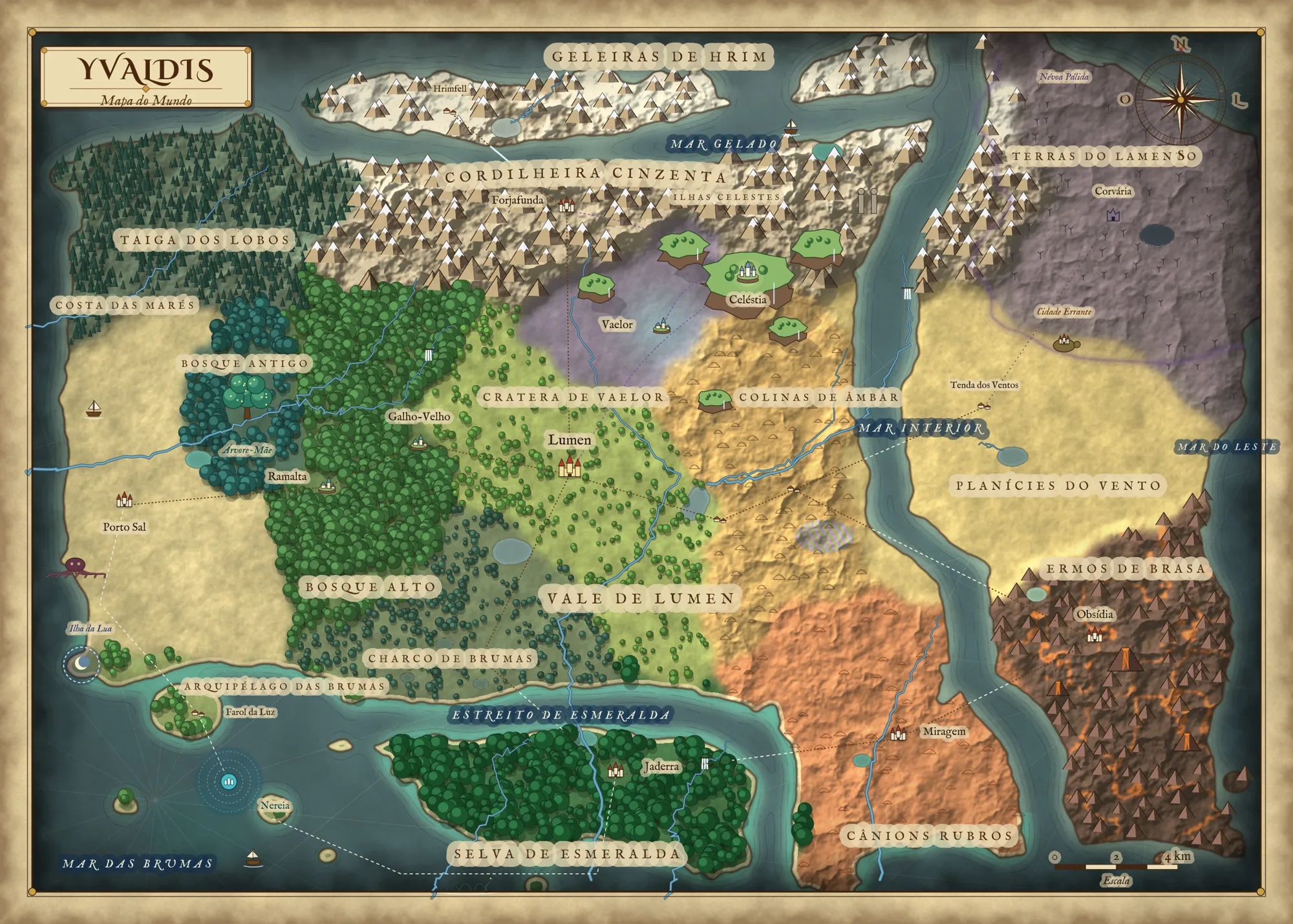
The 18 regions
Source: docs/20 §5. The level range is the home difficulty; the player can visit any region.
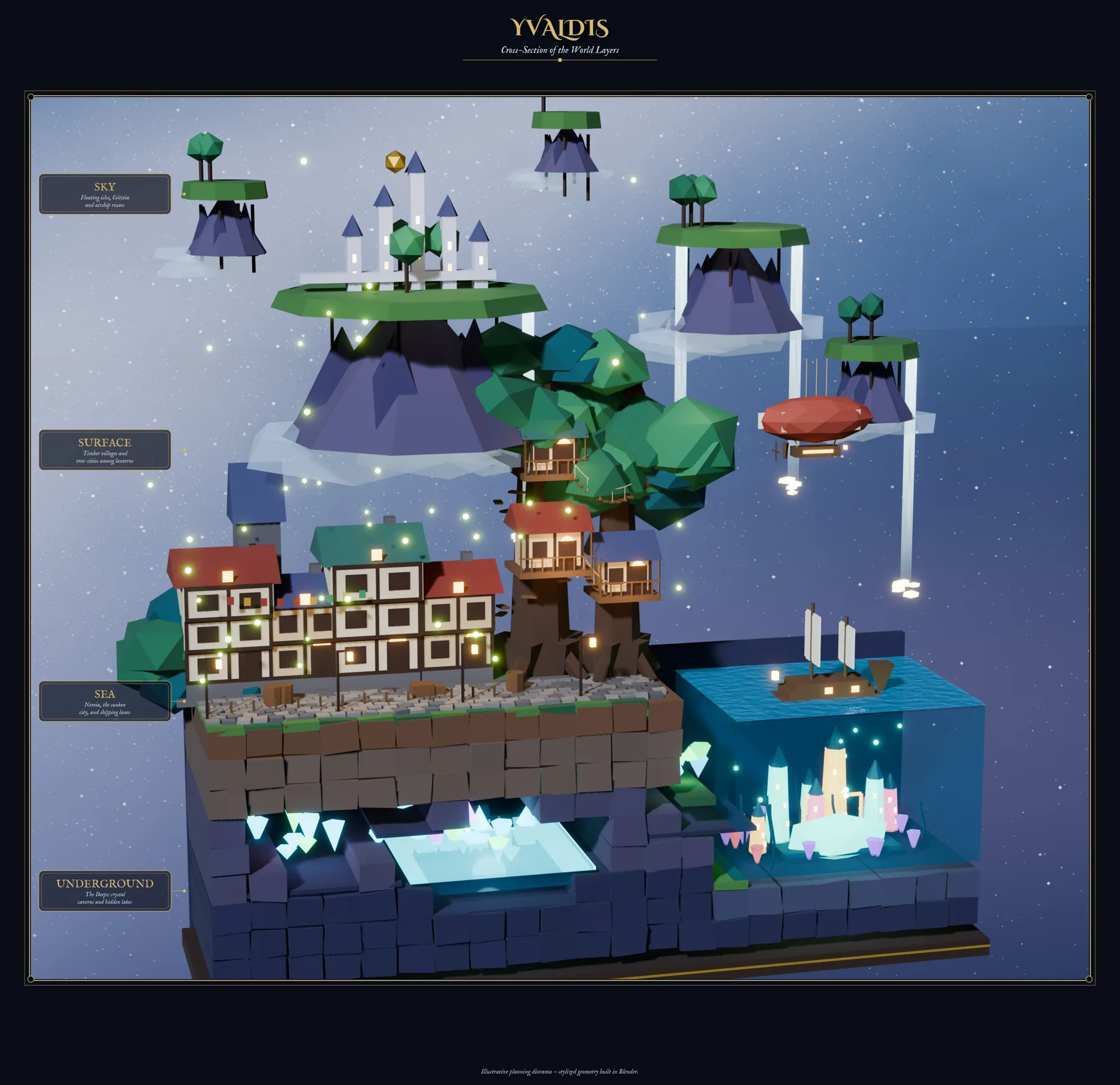
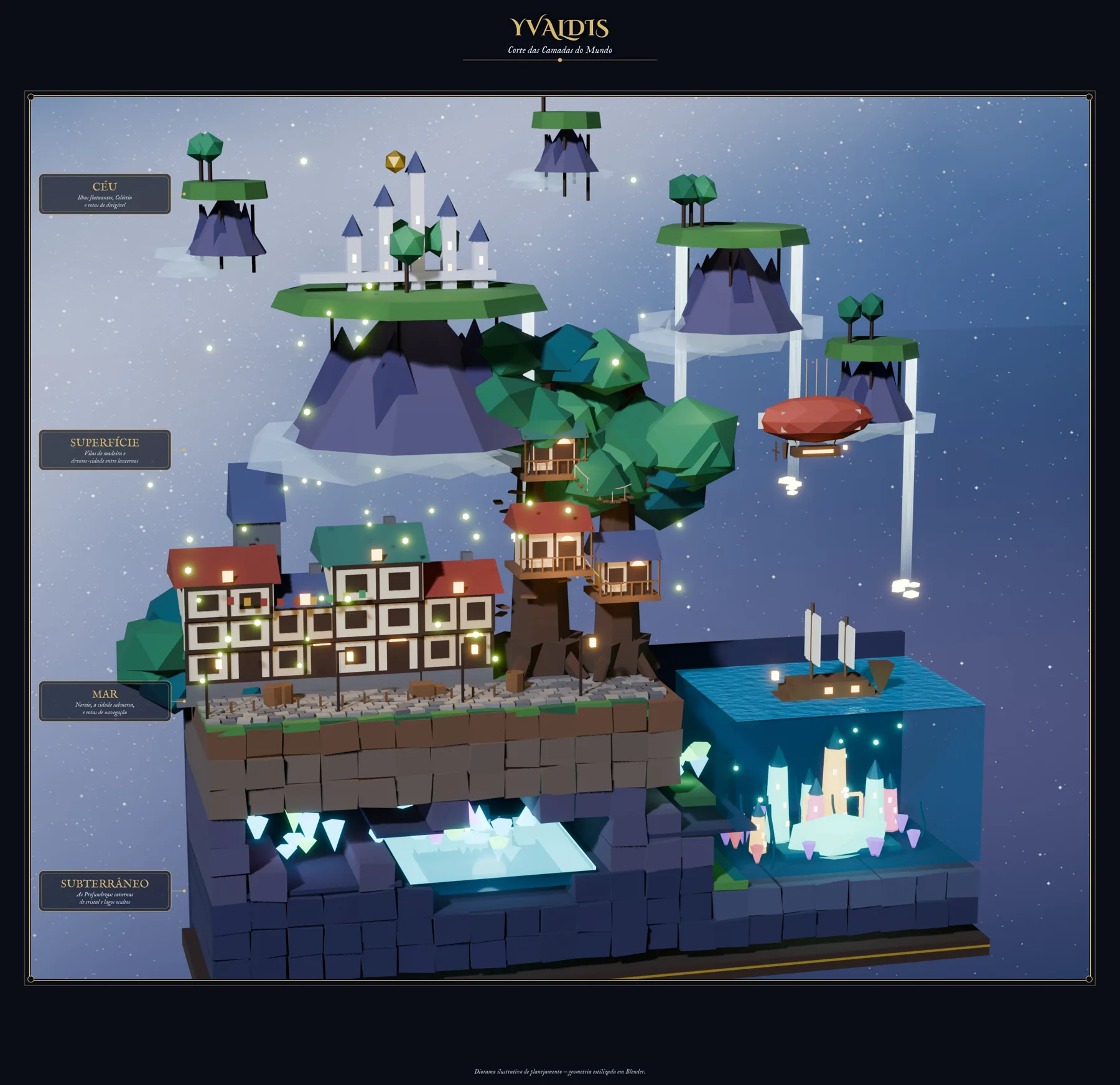
Images generated by modelos/mapa_v1.py and modelos/camadas.py. The relief is procedural and illustrative: the sketch is for discussing regions, distances and routes, not the final terrain. The previous version (v0) was kept at referencias-proprias/mapa-mundo-v0.jpg.
1. What we learned from MMOs that worked (and from those that wore people out)
| Game | What it did well | What we take |
|---|---|---|
| Guild Wars 2 | Dynamic events instead of a quest list: the player hears the farmer shouting and sees the farm burn; if nobody helps, the place changes (the waypoint is blocked, the village is taken). Maps with several floors (Tangled Depths has four layers), mounts with physics that explore the map in 3D instead of jumping over it, fast travel with a cost to encourage walking | Events that change the place; layered regions; mounts that interact with the terrain |
| Throne and Liberty | Weather and time of day change the same place: rain strengthens lightning and leaves puddles that prevent fighting in low areas; at night passive monsters turn aggressive and bosses change in strength and loot. The day cycle does not divide 24 h evenly, so someone who always plays at the same time does not see only daytime. Transformation into animals to cross land, water and air | A cycle that does not close in 24 h; weather with a combat effect; traversal forms per terrain |
| The Elder Scrolls Online (One Tamriel) | Level scaling: any region can be played in any order, and friends of different levels play together | The whole world relevant forever, instead of "old" regions that turn into deserts |
| Black Desert / ArcheAge | Crafts, sailing, trade with routes between regions and the sea as content | Caravan and boat routes that are worth money (see 09, 15) |
| Final Fantasy XIV | Open map events (FATEs), memorable cities, each region with its own music and color identity | Each region with its own theme of music, light and architecture |
| World of Warcraft | Recognizable silhouettes (each zone recalls an image), a cohesive world | Landmarks visible from afar in every region |
| Zelda: Breath of the Wild (not an MMO, but an open-world reference) | Relief hides and reveals: each hill shows a new point of interest | Terrain design in "hide and reveal" along the roads |
Why players tire of MMOs, according to the discussions I researched: daily task lists that become an obligation (fear of losing the streak), progression that only works with the next patch, old content that sits empty, and regions that are "a flat field with hills". The map and the design below answer each of these.
2. Principles so the world doesn't get tiresome
- Each region has its own mechanic, not just a color: in Bosque Alto (High Wood) you walk through the canopy, in the Charco the tide rises and falls, in the Cânions there are sandstorms that hide everything, in the Geleiras the cold drains stamina, in the Terras do Lamento the mist advances.
- The world really changes: dynamic events that leave a mark (a village taken by bandits stays taken until someone liberates it); the Pale Mist advances and recedes depending on players defending the frontier; the Wandering City walks across the map.
- Four layers: sky, surface, sea and underground. The same point on the map can have four different places stacked up.
- Whole world relevant: level scaling (attributes adjust to the region), so any region is worth visiting at any stage of the game and friends of different levels can play together. Scaling applies to PvE only: in PvP there is no scaling, and beginner protection uses equipment power and account age (see
13and23). - No mandatory daily tasks: accumulable weekly rewards and progress that is not lost by spending days without playing.
- Secrets: each region has hidden places (caves behind waterfalls, a door that only opens on the full moon, an island that only appears in fog).
- A clock that does not close in 24 hours: the game day has a length that does not divide 24 h evenly, so someone who always plays at 8 p.m. sees day, dusk and night over the course of the week.
3. Size
- Full world: 40 × 28 km of surface (1,120 km²), about 15 times the map of Red Dead Redemption 2, divided into 70 blocks of 4 × 4 km.
- Adding sky, sea and underground, the explorable area exceeds ~1,500 km².
- Alpha: the 4 × 4 km block around Lumen (16 km²): Vale de Lumen (Lumen Valley) and Bosque Alto, with the settlements Lumen, Espelho (Mirror), Galho-Velho (Old Branch) and Ramalta (High Branch) (§5). Official launch: Chapter 1 (~64 km²: adds Costa das Marés (Tide Coast) with Porto Sal (Salt Port), and Mina Velha (Old Mine)); the rest of the full world (1,120 km²) opens by chapters (see
25,06). - Crossing from west to east: ~8 h on foot, ~2.5 h on horseback, ~40 min by airship.
4. The four layers
| Layer | What it has | How to get there |
|---|---|---|
| Sky | The Ilhas Celestes (Sky Islands), a floating archipelago above the Cratera de Vaelor (Vaelor Crater), with the city of Celéstia; small islands with waterfalls that fall into the void | Airships (Lumen, Forjafunda, Vaelor), rare flying mounts restricted to this layer, wind currents |
| Surface | The 16 surface regions in §5 (the table has 18 rows; Mar de Nereia and Ilhas Celestes belong to the Sea and Sky layers) | On foot, mount, carriage |
| Sea | Nereia, a city submerged in an air bubble; the Abismo de Coral (Coral Abyss); the Navio Fantasma (Ghost Ship); islands | Boats (Porto Sal, Jaderra), diving with equipment or water magic |
| Underground | As Profundezas (the Depths): a cave network under the Cordilheira with an underground city, lakes and bioluminescent fungi | Dungeon 12 (Portões das Profundezas), mines, hidden shafts |
5. Regions
| Region | Biome | Own mechanic | Highlights | Level |
|---|---|---|---|---|
| Vale de Lumen | Plains, fields, lake | Farms that change with the seasons | Capital Lumen, village Espelho, Catacumbas (Catacombs), contested zone Mina Velha | 1–10 |
| Bosque Alto | Colossal trees | Walking through the canopy on bridges and ropes, three levels | Hanging cities Galho-Velho and Ramalta | 5–15 |
| Bosque Antigo (Old Wood) | Primary forest | Bioluminescence that only appears at night; paths that change | The Mother Tree, druids, Nature magic | 15–25 |
| Costa das Marés | Beaches, cliffs | High and low tide opens and closes caves | Porto Sal, Mina Afogada (Sunken Mine) | 10–20 |
| Arquipélago das Brumas (Archipelago of Mists) | Islands | Islands that appear and vanish in the fog | Farol da Luz (Lighthouse of Light), Ilha da Lua (Moon Island) (only on the full moon), Templo Submerso (Sunken Temple) | 25–35 |
| Mar de Nereia (Sea of Nereia) | Seabed | Stamina, currents, light that fades with depth | Submerged city Nereia, Abismo de Coral, Palácio de Coral (Coral Palace) | 30–40 |
| Taiga dos Lobos (Wolf Taiga) | Pines and snow | Tracks in the snow; hunting | Covil dos Lobos Brancos (White Wolves' Den) | 20–30 |
| Cordilheira Cinzenta (Gray Range) | Mountains | Climbing and altitude; contested mines | Forjafunda (Deepforge), entrance to the Profundezas | 25–40 |
| Geleiras de Hrim (Glaciers of Hrim) | Eternal ice | The cold drains stamina; shelter and a campfire needed; ice that cracks | Hrimfell, Caverna de Cristal (Crystal Cave), raid Trono de Gelo (Ice Throne) | 40–50 |
| Cratera de Vaelor | Blue-light crater | Stronger Arcane magic; strange gravity near the center | Vaelor, floating city above the crater; raid Abismo de Vaelor | 35–50 |
| Ilhas Celestes | Sky | Wind changes routes; falling means returning to the surface | Celéstia, Santuário dos Ventos (Sanctuary of the Winds) | 40–50 |
| Planícies do Vento (Wind Plains) | Steppe | Herds of animals; horse races | Tenda dos Ventos (Tent of the Winds), Torre do Mago Louco (Mad Mage's Tower), route of the Wandering City | 15–25 |
| Colinas de Âmbar (Amber Hills) | Vineyards and orchards | Seasonal harvest, festivals | Vinha-d'Âmbar (Amber Vine) | 10–20 |
| Terras do Lamento (Lands of Lament) | Dead land | The Pale Mist advances and recedes depending on players defending against it; undead | Corvária (city in ruins), Cripta do Rei Sem Nome (Crypt of the Nameless King), raid Cidadela do Lamento | 40–50 |
| Ermos de Brasa (Ember Wastes) | Volcanoes | Heat, eruptions that change the terrain, lava rivers | Obsídia, Forja de Magma (Magma Forge), raid Coração do Vulcão | 40–50 |
| Cânions Rubros (Red Canyons) | Desert | Sandstorms that hide everything; thirst | Miragem (merchants' oasis), Tumbas de Areia (Tombs of Sand) | 30–40 |
| Selva de Esmeralda (Emerald Jungle) | Tropical jungle | Dense vegetation; swallowed ruins; near-daily rain | Jaderra, Pirâmide do Sol (Pyramid of the Sun) | 25–35 |
| Charco de Brumas (Mist Marsh) | Swamp | Water rises with the rain; plank trails | Palafitas (Stilts), Ninho das Mariposas (Moth Nest) | 20–30 |
With level scaling (principle 4), the level range is the origin difficulty; the player can visit any region.
6. Unique places
- The Wandering City: a city on the back of a giant turtle that travels the Planícies do Vento in a circuit of real days. Merchants, quests and rare items; finding it becomes an event.
- Celéstia and the Ilhas Celestes: a city on floating islands, with waterfalls that fall into the void.
- Nereia: a city submerged in an air bubble, next to the Abismo de Coral.
- Vaelor: a city floating above the blue crater.
- The Pale Mist: a living frontier in the northeast; if players don't hold it back, it swallows villages, which return when the mist recedes.
- Ilha da Lua: only appears on full-moon nights.
- The Mother Tree: the largest tree in the world, visible from almost all of the west.
- Desfiladeiro dos Gigantes (Giants' Gorge): colossal statues flanking a pass in the Cordilheira.
7. Continents, seas and hard-to-reach places
Owner's request: having the whole world reachable on foot made the map feel "glued together". Now the world is an archipelago of landmasses, and part of the content requires transport, preparation or skill.
Landmasses (4) and seas:
- Hrim (the frozen north), separated by the Mar Gelado (Frozen Sea). The sea freezes in winter: in that season you can cross on foot or by sled (ice crossing); the rest of the year, only by boat. A bridge that "exists for only one season" is an event in itself.
- The Continent (center and west: Lumen, forests, mountain range, crater, coast). It is the heart and the launch block.
- As Terras do Leste (the Eastern Lands) (Terras do Lamento, Planícies do Vento, Ermos de Brasa, Cânions Rubros), separated by the Mar Interior (Inner Sea). You get there by ferry from the port cities or by airship. It is the second great chapter of the world.
- Esmeralda (the southern jungle), separated by the Estreito de Esmeralda (Emerald Strait). Only by boat: reaching the jungle is a journey.
- Islands of various sizes: Arquipélago das Brumas, Ilha das Sereias (Mermaid Island), Ilha das Tempestades (Storm Island), Ilha da Lua, Ilha das Tartarugas (Turtle Island), islets in the south and east.
How to cross (from easiest to hardest):
- Ferry between ports: cheap, on a schedule, and the trip is playable (the boat crosses the sea in real time, with events on board).
- Own boat (made by a shipwright or bought): goes to any coast, including islands without a port.
- Airship (fixed routes between the big cities, more expensive, fast).
- Ice crossing (winter only, on the Mar Gelado).
- Flying mount (high level, expensive to maintain, does not fly in storms or near the Pale Mist). It never unlocks the whole world: no-fly zones over cities, dungeons and protected islands.
- Special mounts: aquatic mount for coasts and rivers, climbing mount for cliff walls.
Hard-to-reach places (yellow triangle on the map):
- Ilha das Tempestades: only by boat, crossing a ring of storms with waves, lightning and possible shipwreck. Inside, a dungeon and rare ore.
- Planalto Suspenso (Hanging Plateau): a mesa with vertical walls in the middle of the jungle. Climbing or a flying mount; no easy path. Up there, an isolated ecosystem with plants and animals that exist nowhere else.
- Pico do Mundo (Peak of the World): the highest point. The climb demands cold gear, hot food and stamina; avalanches and winds. From the summit you see the whole world (the biggest "wow" in the game).
- Ilha das Sereias: only by boat, against currents. Reward: rare aquatic alchemy.
- Others already on the map: Ilha da Lua (only on the full moon), Abismo de Coral (only with water breathing), Profundezas (only with light and rope).
Rules so that the hard stuff stays worthwhile:
- No direct teleport to a hard-to-reach place. Teleport between cities may exist; the hard place requires getting there.
- The reward is unique: ingredients, ores, creatures and landscapes that exist nowhere else. This feeds the economy (whoever gets there sells for gold). Each rare material has one smaller alternative source (slower or more expensive), and the entrance has a safe arrival zone.
- Difficulty of skill and preparation, not just level: an experienced, well-prepared player can do it; a high-level, unprepared one fails.
- Failing costs no items (project rule); it costs time, durability and consumables.
- Groups and clans organize expeditions: a boat captain, a climber, an alchemist.
8. Water and paradise landscapes
Owner's request: paradise landscapes are an ideal of the game. Water is what most makes a place feel alive in first person (and in VR), so the world has:
Rivers (11): the main river from the Cordilheira to the south, passing through Lumen; the Rio do Véu (Veil River) (Bosque Alto); the Rio dos Lobos (Wolf River) (Taiga); the Rio Esmeralda (Selva); the Rio das Mil Quedas (Cânions to the Selva); the Rio das Colinas; the Geleiras meltwater; and tributaries. Rivers are navigable by small boat in the wide stretches and have fishing by species.
Lakes and ponds (10): Lago de Lumen, Lago Gelado (freezes in winter, ice fishing), Lago de Cristal (in the Cordilheira, turquoise water and a bed of crystals), Lago dos Cavalos (in the Planícies), Lago Negro (Terras do Lamento, with something living at the bottom), the Oásis de Miragem, the Fontes Termais dos Ermos (hot water in the middle of the volcano), the Lagoa das Fadas (Bosque Antigo, with lights at night), the Lagoa Verde (Selva) and the puddles of the Charco.
Waterfalls (8): the Véu da Noiva (Bride's Veil) (Bosque Alto), the Salto do Gigante (Giant's Leap) (Cordilheira, the largest in the world), the Queda das Marés (falls directly into the sea), the Mil Quedas (an entire valley of waterfalls between the Cânions and the Selva) and smaller ones. Behind several of them are hidden caves.
Paradise landscapes: 9 listed below, plus 8 in 21 (17 in total, all marked with a flower on the map).
| Place | Region | What it is |
|---|---|---|
| Praia das Conchas | South coast | White sand, turquoise water and palm trees |
| Lagoa Turquesa | Arquipélago | Clear-water lagoon surrounded by islands |
| Vale das Mil Quedas | Selva / Cânions | Dozens of waterfalls in a green valley |
| Fontes Termais | Ermos de Brasa | Hot pools with steam in the middle of the volcano |
| Lago de Cristal | Cordilheira | Turquoise mountain lake with crystals |
| Oásis de Miragem | Cânions Rubros | Palm trees and water in the middle of the red desert |
| Campos de Lavanda | Colinas de Âmbar | Purple fields in bloom in spring and summer |
| Lagoa das Fadas | Bosque Antigo | Pond with floating lights at night |
| Jardins de Celéstia | Ilhas Celestes | Hanging gardens with waterfalls that fall into the void |
Each paradise landscape is a rest area: no PvP, recovery bonus, fishing, its own music, and a great place to live (the land near them is the most contested, see 15). The coasts of the south and the archipelago have turquoise sea, white sand and palm trees, and the tropical climate is warm all year.
9. Cities
| Type | Cities |
|---|---|
| Capital | Lumen |
| Hanging and floating | Galho-Velho and Ramalta (in the trees), Vaelor (above the crater) |
| Of the sky | Celéstia |
| Submerged | Nereia |
| Mobile | The Wandering City |
| In ruins | Corvária |
| Cities | Porto Sal, Forjafunda, Obsídia, Miragem, Jaderra |
| Villages | Hrimfell, Tenda dos Ventos, Palafitas, Farol da Luz, Vinha-d'Âmbar, Espelho |
10. Dungeons and raids
18 dungeons (party of 5): 1 Catacumbas de Lumen, 2 Raízes Ocas (Hollow Roots), 3 Mina Afogada, 4 Covil dos Lobos Brancos, 5 Fornalha Esquecida (Forgotten Furnace), 6 Templo Submerso, 7 Ruínas Arcanas (Arcane Ruins), 8 Ninho das Mariposas, 9 Tumbas de Areia, 10 Forja de Magma, 11 Caverna de Cristal, 12 Portões das Profundezas (Gates of the Depths), 13 Torre do Mago Louco, 14 Navio Fantasma, 15 Pirâmide do Sol, 16 Cripta do Rei Sem Nome, 17 Santuário dos Ventos, 18 Palácio de Coral.
4 raids (20 players): Abismo de Vaelor, Coração do Vulcão (Heart of the Volcano), Trono de Gelo and Cidadela do Lamento (Citadel of Lament).
Chapter 1 addition (29): the Gruta das Marés (Tide Grotto) (Costa das Marés, party of 5, only opens at low tide) is a new dungeon, outside this list of 18; Chapter 1 has 4 dungeons (Catacumbas de Lumen, Raízes Ocas, Gruta das Marés, Mina Afogada).
11. PvP and routes
- Launch contested zone: Mina Velha (levels 8–14,
29), near Lumen: open PvP only in scheduled windows, 6 concessions of common material (see15and19). Outside the windows, it is a consent zone. - Contested zones in the expansions: the edge of the Cratera de Vaelor (crystals), the mines of the Cordilheira and the frontier of the Ermos de Brasa (see
13). - Hard-to-reach places have a safe arrival zone at the entrance (no PvP and no clan blocking), and each rare material has a smaller alternative source.
- Roads link the cities to Lumen; an old, dangerous road leads to Corvária.
- Ports: Porto Sal, Farol da Luz, Nereia, Jaderra and, new, Obsídia (Mar Interior, Terras do Leste), Porto de Corvária (on the side of the city in ruins, far from the Pale Mist) and Hrimfell (Mar Gelado, Hrim). Miragem is inland and is served by airship.
- Routes (each landmass has at least one port and one route):
| Route | Type | Links |
|---|---|---|
| Porto Sal ↔ Obsídia | Ferry | Continent ↔ Terras do Leste (Mar Interior) |
| Obsídia ↔ Porto de Corvária | Coastal ferry | Within the Terras do Leste |
| Porto Sal ↔ Jaderra | Ferry | Continent ↔ Esmeralda (Strait) |
| Porto Sal ↔ Hrimfell | Ferry (in winter also over the ice) | Continent ↔ Hrim (Mar Gelado) |
| Porto Sal ↔ Farol da Luz | Ferry | Continent ↔ Brumas |
| Porto Sal ↔ Nereia | Boat and diving | Coast ↔ submerged city |
| Lumen ↔ Miragem | Airship | Continent ↔ Terras do Leste |
| Forjafunda ↔ Obsídia | Airship | Continent ↔ Terras do Leste |
| Lumen, Forjafunda, Vaelor ↔ Celéstia | Airship | Surface ↔ Sky |
Airships do not pass near the Pale Mist.
12. Next steps
- Owner review: names, positions, what is missing.
- Redo the land distribution (
15) on top of this map. - Detailed map of the launch block, the basis of the proof of concept.
- Music and palette per region (one page per region, in the style of
02).